Artist: Jan Matejko
Year: 1873
Artistic period: Polish historical painting
Historical figure depicted: Nicolaus Copernicus (1473–1543)
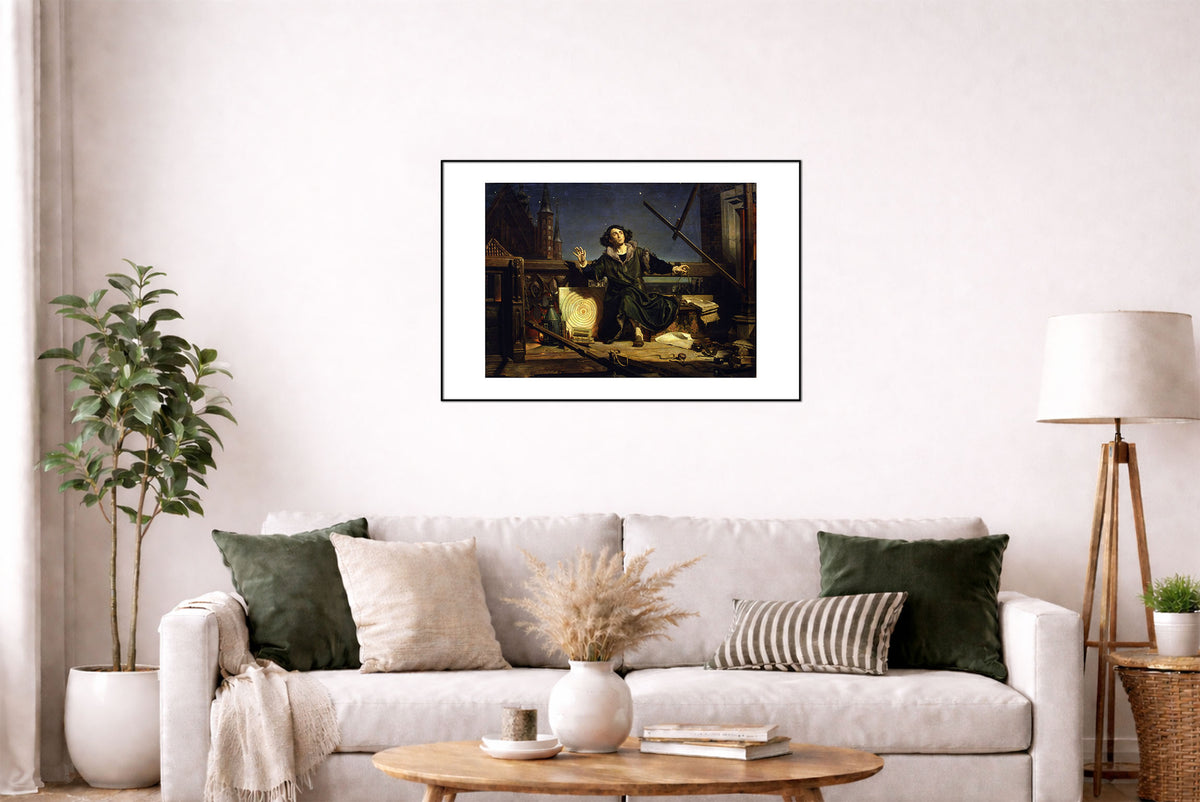
This is a reproduction print of the celebrated historical painting “Copernicus the Astronomer, or Conversations with God” (Astronom Kopernik, czyli rozmowa z Bogiem), created by Polish painter Jan Matejko in 1873. The artwork depicts Nicolaus Copernicus standing beneath the night sky, absorbed in a moment of scientific discovery and spiritual contemplation. One of Matejko's most recognizable paintings, it celebrates the achievements of the Renaissance astronomer whose revolutionary theory transformed humanity's understanding of the universe. The original artwork is housed at the Jagiellonian University Museum in Kraków, Poland.
The painting was completed in 1873 to commemorate the 400th anniversary of Copernicus's birth. Born in Toruń in 1473, Nicolaus Copernicus (Mikołaj Kopernik) studied at the University of Kraków before continuing his education in Italy. He became a mathematician, astronomer, physician and canon of the Warmian Cathedral Chapter. His most important achievement was the development of the heliocentric model of the Solar System, which placed the Sun near the center of the planetary system and described the Earth as a planet moving around it.
Copernicus presented his theory in “De revolutionibus orbium coelestium” (On the Revolutions of the Heavenly Spheres), published in Nuremberg in 1543, the year of his death. His work challenged the long-established geocentric model associated with Ptolemy and became a foundational contribution to the Scientific Revolution. Although the acceptance of heliocentrism took generations and required further discoveries by astronomers such as Johannes Kepler and Galileo Galilei, Copernicus fundamentally changed the direction of European astronomy.
Matejko portrays Copernicus standing on a wooden observation platform overlooking the rooftops of Frombork, where the astronomer spent much of his professional life. Dressed in a richly colored robe, he raises his hands toward the heavens, his face illuminated by an extraordinary light. Beside him lie astronomical instruments, manuscripts and a diagram of the heliocentric planetary system, emphasizing the relationship between mathematical reasoning and observation.
The painting's dramatic composition suggests a moment of profound revelation. Copernicus appears to be contemplating the divine order of the universe, giving visual expression to the artwork's title, “Conversations with God.” Rather than depicting a documented historical event, Matejko created a symbolic scene combining scientific inquiry, religious reflection and intellectual inspiration. The illuminated figure of Copernicus contrasts with the darkness of the surrounding architecture and night sky, suggesting the emergence of new knowledge from uncertainty.
The artwork also carries an important national dimension. Created during the Partitions of Poland, when Polish territories were divided between Russia, Prussia and Austria, the painting celebrated one of the most influential scholars associated with Polish history. For Matejko, portraying Copernicus was a way of emphasizing Poland's contribution to European science, Renaissance culture and intellectual achievement at a time when the Polish state no longer existed as an independent political entity.
The composition is distinguished by dramatic lighting, richly detailed Renaissance clothing, atmospheric architecture and carefully rendered scientific instruments. Matejko combines the precision of historical painting with the emotional intensity of a visionary scene, transforming Copernicus into a symbol of human curiosity, intellectual courage and the pursuit of truth.
Painted in oil on canvas, the original artwork measures approximately 225 × 315 cm. Jan Matejko (1838–1893) was one of Poland's greatest historical painters, celebrated for monumental compositions depicting the country's political, military and cultural history.
Today, “Copernicus the Astronomer, or Conversations with God” remains one of the most celebrated works of 19th-century Polish historical painting, admired for its powerful representation of Nicolaus Copernicus, the heliocentric revolution, Renaissance astronomy and the relationship between science, faith and human discovery.