Artist: Jan Matejko
Year: 1889
Artistic period: Polish historical painting
Historical event: Christianization of Poland, 966
Series: History of Civilization in Poland (Dzieje cywilizacji w Polsce)
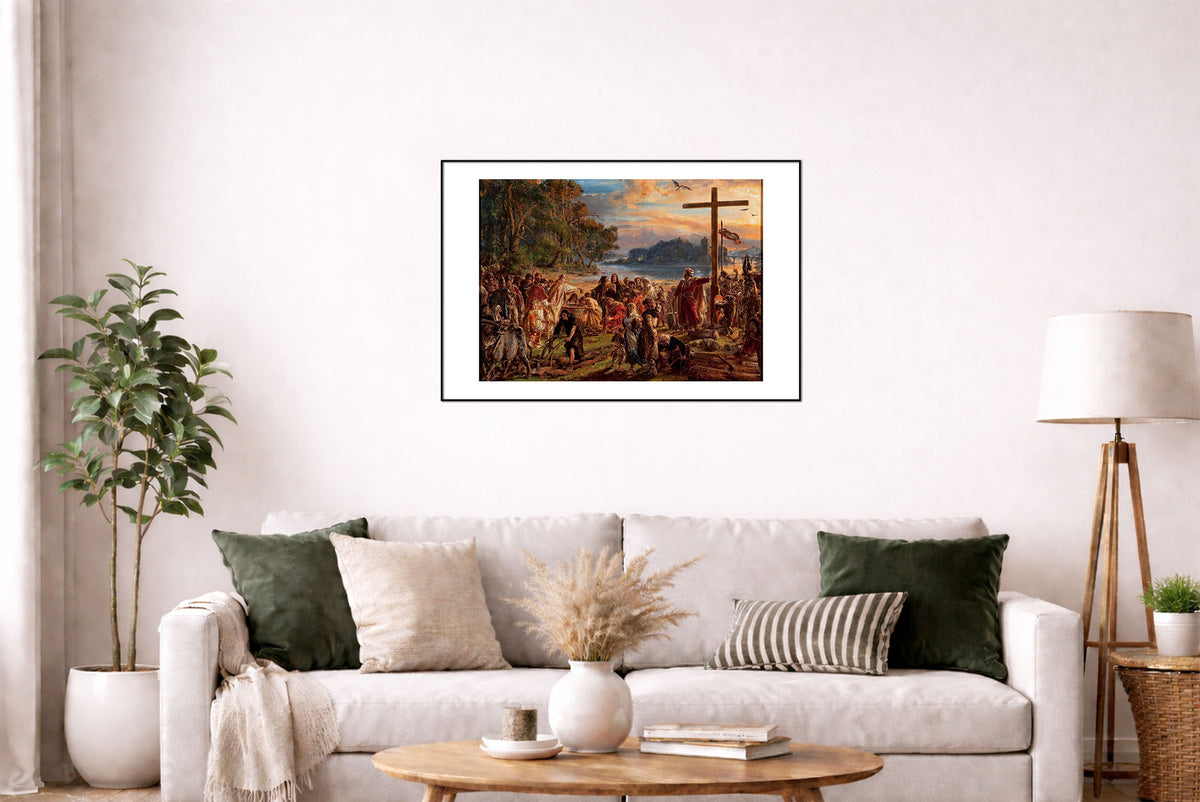
This is a reproduction print of “Introduction of Christianity” (Zaprowadzenie chrześcijaństwa), a historical painting created by Jan Matejko in 1889. The artwork portrays the symbolic beginnings of Christianity in Poland, associated with the baptism of Duke Mieszko I in 966, one of the defining events in Polish history. Through a carefully arranged gathering of historical figures, religious symbols and early medieval architecture, Matejko illustrates the transformation of the emerging Polish state and its integration into Christian Europe.
The Baptism of Poland in 966 traditionally marks the beginning of Christianity as the religion of the Piast ruling dynasty and a turning point in the formation of the Polish state. Mieszko I, the first historically documented ruler of Poland, governed a growing polity centered in the territories of the early Piast dynasty. His acceptance of Christianity strengthened diplomatic relations with neighboring Christian rulers and helped integrate his realm into the political and religious structures of medieval Europe.
An important figure in this transformation was Dobrawa (Dąbrówka), a Christian princess from the Bohemian Přemyslid dynasty who married Mieszko I in 965 or 966. Medieval tradition associates her with encouraging the ruler's conversion. Mieszko's baptism was followed by the gradual establishment of ecclesiastical institutions, including the missionary bishopric of Poznań in 968, traditionally associated with Bishop Jordan.
Matejko's composition presents a symbolic gathering connected with the adoption and establishment of Christianity, rather than a strictly documentary reconstruction of Mieszko's baptism. Religious figures, representatives of the ruling elite and members of the community are brought together in a scene that emphasizes the relationship between faith, political authority and the development of early Polish statehood.
The painting also reflects the historical importance of the Piast dynasty, which played a central role in consolidating the territories that would become the Kingdom of Poland. The Christianization process extended far beyond a single ceremony in 966: the spread of the new religion, construction of churches, formation of ecclesiastical structures and transformation of religious practices continued over generations. Matejko condenses this long historical process into a single visually expressive composition.
The artwork belongs to Matejko's celebrated series “History of Civilization in Poland” (Dzieje cywilizacji w Polsce), a cycle of twelve paintings completed in 1888–1889. Rather than focusing exclusively on battles and rulers, the series explores major political, religious, cultural and institutional developments in Polish history. “Introduction of Christianity” serves as the opening chapter of this historical narrative, emphasizing the role of Christianization in the development of medieval Polish civilization.
Created during the Partitions of Poland, when Polish territories were divided between Russia, Prussia and Austria, the series also carried a powerful cultural meaning. By presenting the origins and development of Polish institutions, Matejko emphasized the historical continuity of the Polish nation at a time when the country lacked political independence.
The composition reflects Matejko's distinctive approach to historical painting through expressive figures, carefully selected historical details, symbolic gestures and an emphasis on the relationship between individuals and major historical transformations. Rather than simply illustrating a religious ceremony, the artist invites viewers to consider how the adoption of Christianity influenced Polish politics, education, architecture, literacy and cultural identity.
Jan Matejko (1838–1893) was one of Poland's greatest historical painters, renowned for monumental works depicting the political, military and cultural history of Poland and the Polish-Lithuanian Commonwealth. His paintings helped shape the visual imagination of Polish history for generations.
Today, “Introduction of Christianity” remains an important representation of the Baptism of Poland in 966, Mieszko I, Dobrawa and the emergence of the medieval Polish state, combining historical interpretation with the artistic traditions of 19th-century Polish historical painting.